Hair Transplant Scar Camouflage: Client M385 After Session One
Client M385 After Session One
When a hair transplant is done with the FUT, or strip, method, it leaves a linear scar across the back of the head. For many men, that scar is easy to live with when the hair around it is kept longer. Once the hair is worn short or shaved, the pale band stands out much more clearly against the surrounding scalp.
This post looks at Client M385, a recent scar camouflage case at SCALPMICRO.CA in Edmonton. Mitchell Stals treated a FUT strip scar with scalp micropigmentation (SMP). The photos and video here show the result after Session One, the foundation stage. This is not a finished treatment. You can see the full set of images on his client profile.
The scar before treatment
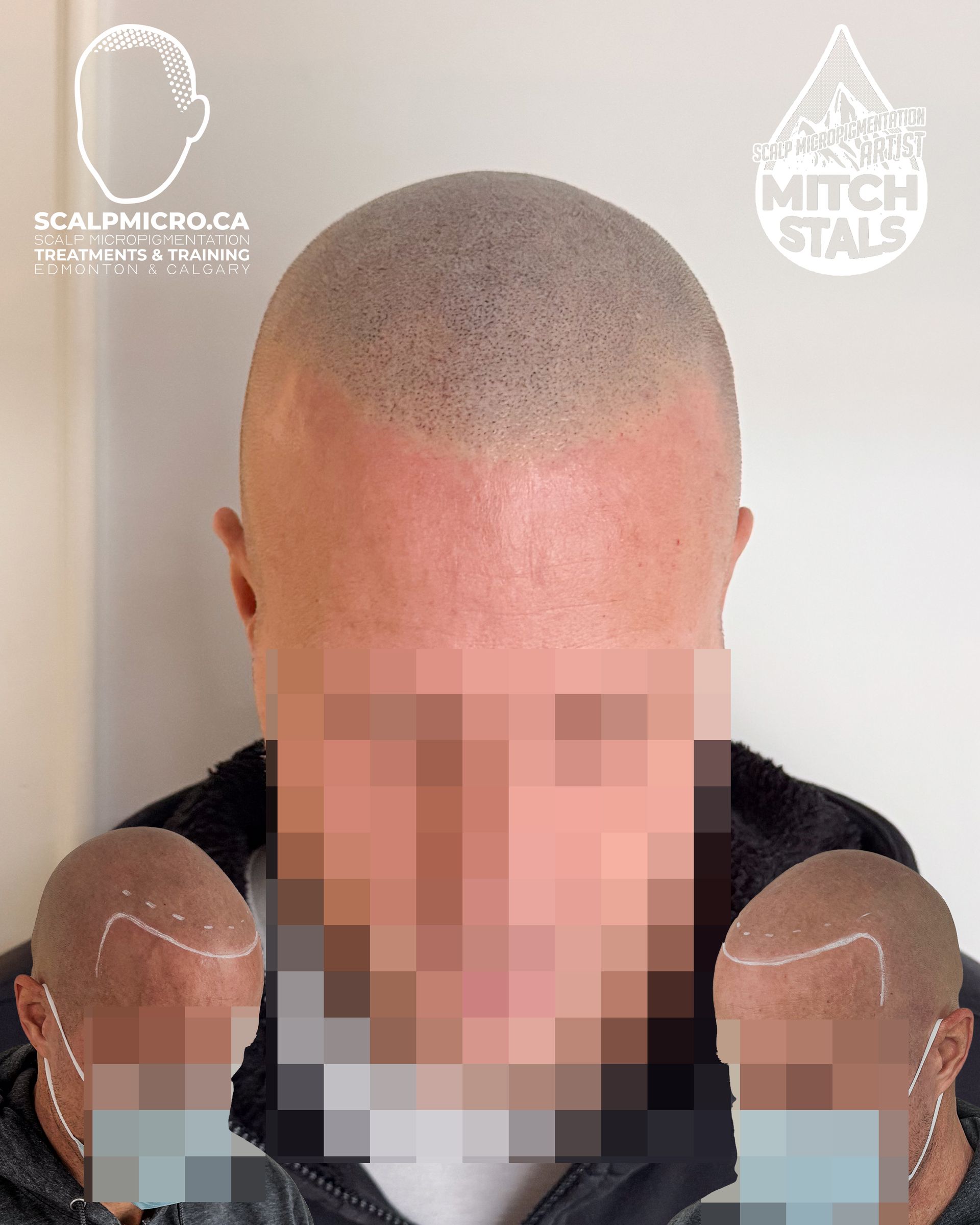
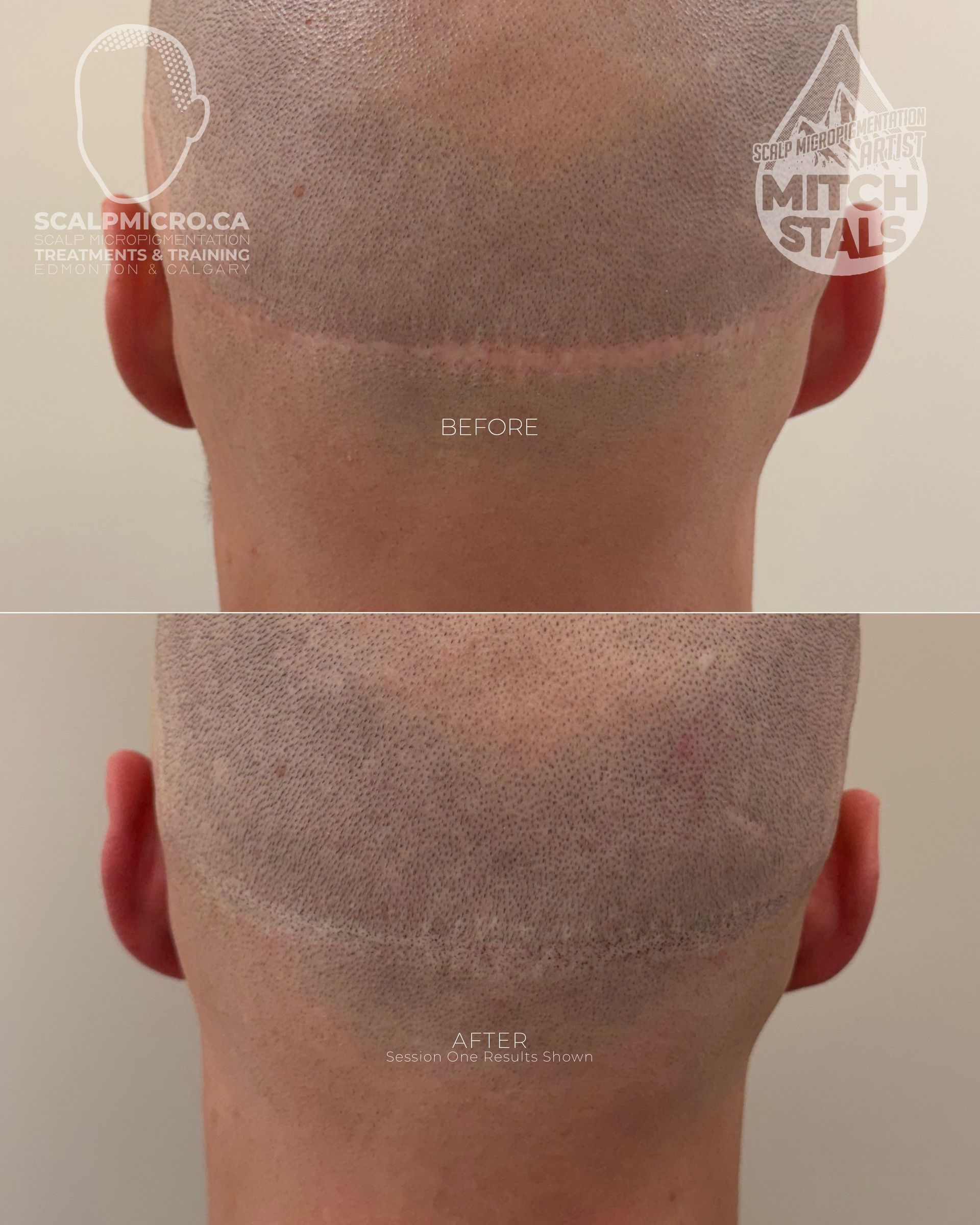
From directly behind, the scar runs in a fairly straight line from ear to ear, low on the back of the head. It is a pale, pinkish band with little to no hair in the scar itself, set against a closely shaved scalp. From the side, that same line wraps up behind the ear. On one side, a short stretch of the scar is a little wider and lighter than the rest. That unevenness is common with strip scars — they are not always consistent along their full length.
The before half of the photo above shows the starting point. Scar camouflage, sometimes called scar concealment or blending, is about helping that lighter tissue sit more naturally with the hair around it. How far the blend can go depends on the scar.
After Session One
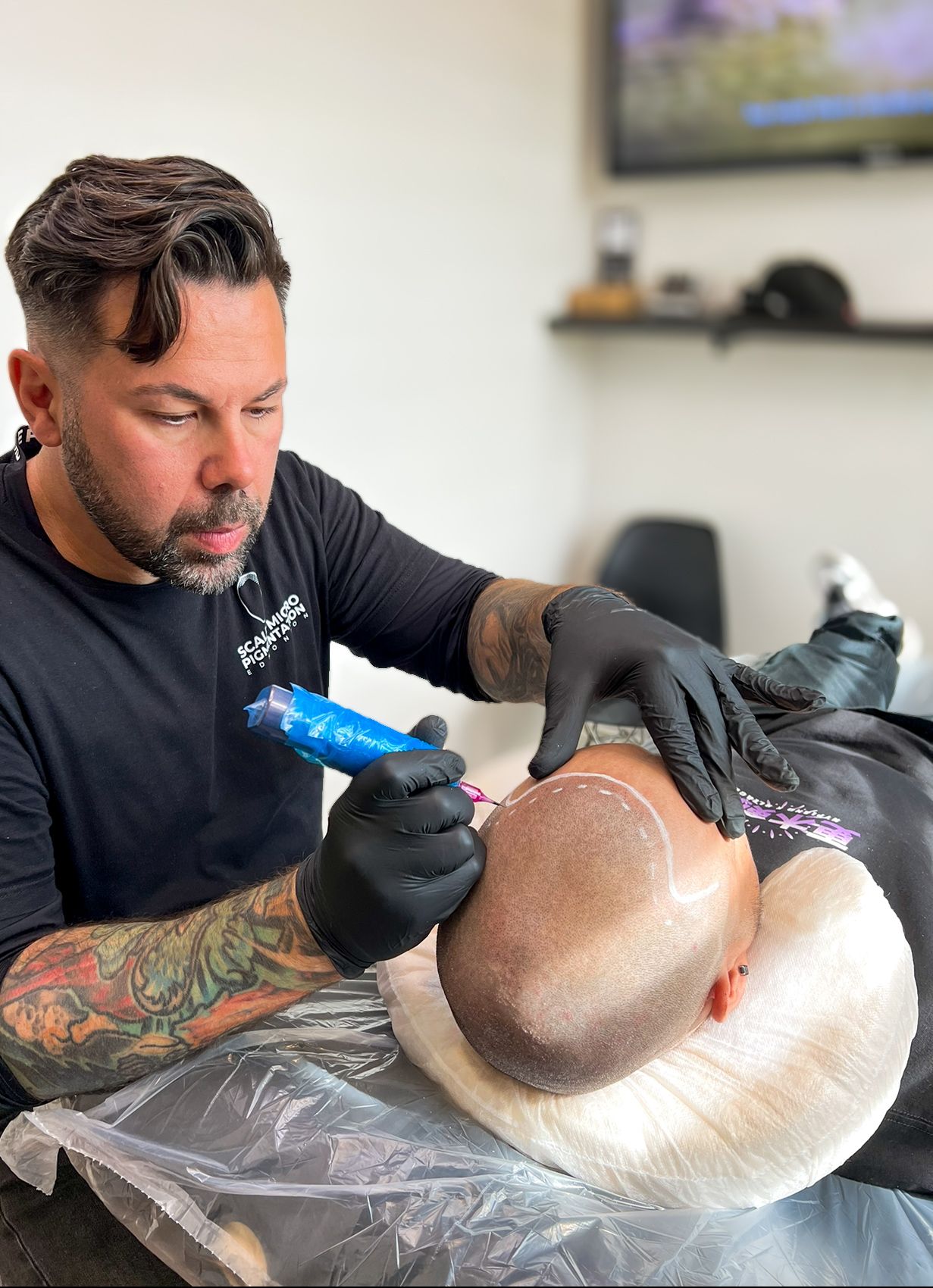
Session One is about laying a foundation. Mitchell places an initial layer of pigment along the scar and into the surrounding scalp, in a pattern meant to resemble closely shaved hair. The aim at this stage is to start softening the contrast of the pale strip so the surface reads more evenly.
In the rear view, the horizontal band is already less conspicuous. Pigment dots now run through the scar and into the hair around it, so the line no longer stands out as a bare streak. A slightly lighter path is still visible in places, which is expected after one session. Scar tissue often takes pigment differently than the skin beside it, and density is built gradually.
Along most of the scar, the blend with the surrounding buzzed hair is already clearer, though the wider, paler stretch near the ear still reads a little lighter than the scalp around it. That is honest Session One work — a solid start, not a finished blend.
You can also watch a short video of this case below, and browse more hair transplant scar camouflage examples in our FUT and FUE before and after gallery.
What typically comes next
SMP is usually planned across three sessions, with healing time between each one. Session Two is typically when more density is added and the blend is refined. Session Three is the finishing stage, where details are tightened up.
Scar camouflage usually requires more sessions than a standard treatment, because scar tissue takes pigment differently than unscarred scalp. Results vary with the size, texture and colour of the scar, and with how the skin responds as it heals. We do not promise a particular outcome for later sessions. What you see here is Session One only.
Scar camouflage pricing and a free consultation
At ScalpMicro, scar camouflage treatment is priced from $1,250 to $2,000, depending on the size and number of scars. The best way to get a figure for your own situation is a consultation, where Mitchell can look at the scar and talk through a realistic plan. Current ranges are on our pricing page.
If you have a FUT or FUE transplant scar, or another scalp scar you would like to blend, you are welcome to schedule a free consultation at our Whyte Avenue studio in Edmonton, or call 587-855-0657.
SCALPMICRO.CA
📍 10422 81 Ave, Edmonton, Alberta
📞 587-855-0657
✉️ hello@scalpmicro.ca
🌐 scalpmicro.ca